Reflections on workplace stress, self-employment and learning that you don't have to do everything yourself.
Wednesday 4 November marks Stress Awareness Day 2026, and this year's theme is Shaping the Future of Stress and Wellbeing: Rehumanising the Workplace.
Workplace stress isn't always about one overwhelming responsibility. In the charity sector, it can build through competing priorities, limited capacity and the pressure to be everything to everyone. My experience taught me the importance of clearer boundaries, better communication and recognising when to ask for support.
Many of us spend a significant chunk of our lives at work, whether that's in an office, at home or out in our communities. So, when work becomes a source of stress, the impact can reach far beyond our working hours.
This time last year, that was me.
In my experience, stress is an interesting beast. It's rarely one thing you can easily pinpoint. It creeps up on you, often so gradually that you don't recognise what's happening until it becomes all-consuming.
I'd spent years building an identity around being someone who gets things done. Someone conscientious, resourceful and dependable. Someone who could juggle multiple priorities, solve problems and always find a way forward.
I'm also a perfectionist, although I always cringe slightly when I say that. It sounds like one of those answers people give in job interviews when they're trying to disguise a strength as a weakness!
The reality is much less impressive. For me, perfectionism means overthinking, overworking and spending far too much time on things that were probably good enough hours ago. Thankfully, I've got much better at recognising this, largely because I've finally accepted that perfection doesn't actually exist. If that's news to you, perhaps it's something worth reflecting on too!
I'd created so much pressure to be at the top of my game, all the time, that in many ways I'd become my own worst enemy. Of course, there were external pressures too. Stress rarely exists in isolation, and no amount of personal resilience can make an unrealistic workload sustainable.
Looking back, friends, family and colleagues could see how much I was struggling long before I was ready to acknowledge it myself.
Eventually, I did. Although, if I'm being completely truthful, there was a period when I knew something wasn't right but decided it was easier to keep powering through than open that particular can of worms.
The trouble is, the can has to open eventually. Let the worms breathe!
I spoke to my employer, sought support and took some time away from work to recover. Even that came with its own challenges, particularly feelings of guilt and shame about stepping away.
"How will the organisation cope without me?"
A valuable lesson here: it will! No matter how much responsibility you carry or how indispensable you might feel, the world doesn't stop turning when you take a step back.
I started prioritising things that brought me joy outside of all the roles I occupied as a mum, wife, daughter, friend and colleague. Pottery, walks on the beach and losing myself in the alternate realities of a good book became part of finding myself again.
As I began to feel more like me, I also started thinking seriously about what I wanted from life and work, and realised something needed to change.
So, after many years in employment, I made the decision to leave the security of a job I knew and step into the big, wide world of self-employment. Something that, until then, I hadn't really considered was even an option for me.
Nine months later, what have I learnt?
1. Changing old habits takes time
I didn't suddenly become a carefree, boundary-setting freelancer the moment I handed in my notice!
Those habits I'd developed over years of working haven't magically disappeared. I still have to remind myself that not everything needs to be perfect, that I don't have to say yes to everything and that being busy isn't necessarily the same as being productive.
I've become much more conscious of how I spend my time, the work I take on and the boundaries I need to protect.
I work around my family, monitor my hours and try not to take on work that doesn't feel right, even when I don't know exactly where the next project is coming from.
That last one is particularly challenging when you're self-employed, but I figure if I can't create a working life that feels joyful and meaningful when I'm the one calling the shots, then what chance do I have?
I'm still learning, and probably always will be. I've always considered myself fairly self-aware, but I've come to realise there's a big difference between recognising your own behaviours and actually doing something to change them.
These days, I'm much better at spotting when those old habits start creeping back in and, importantly, doing something about it before they take over.
Oh, and I've taken up crocheting! Turns out there's something quite liberating about getting over yourself enough to try something new, accepting that you won't be brilliant at it straight away and learning to embrace the odd wonky stitch.
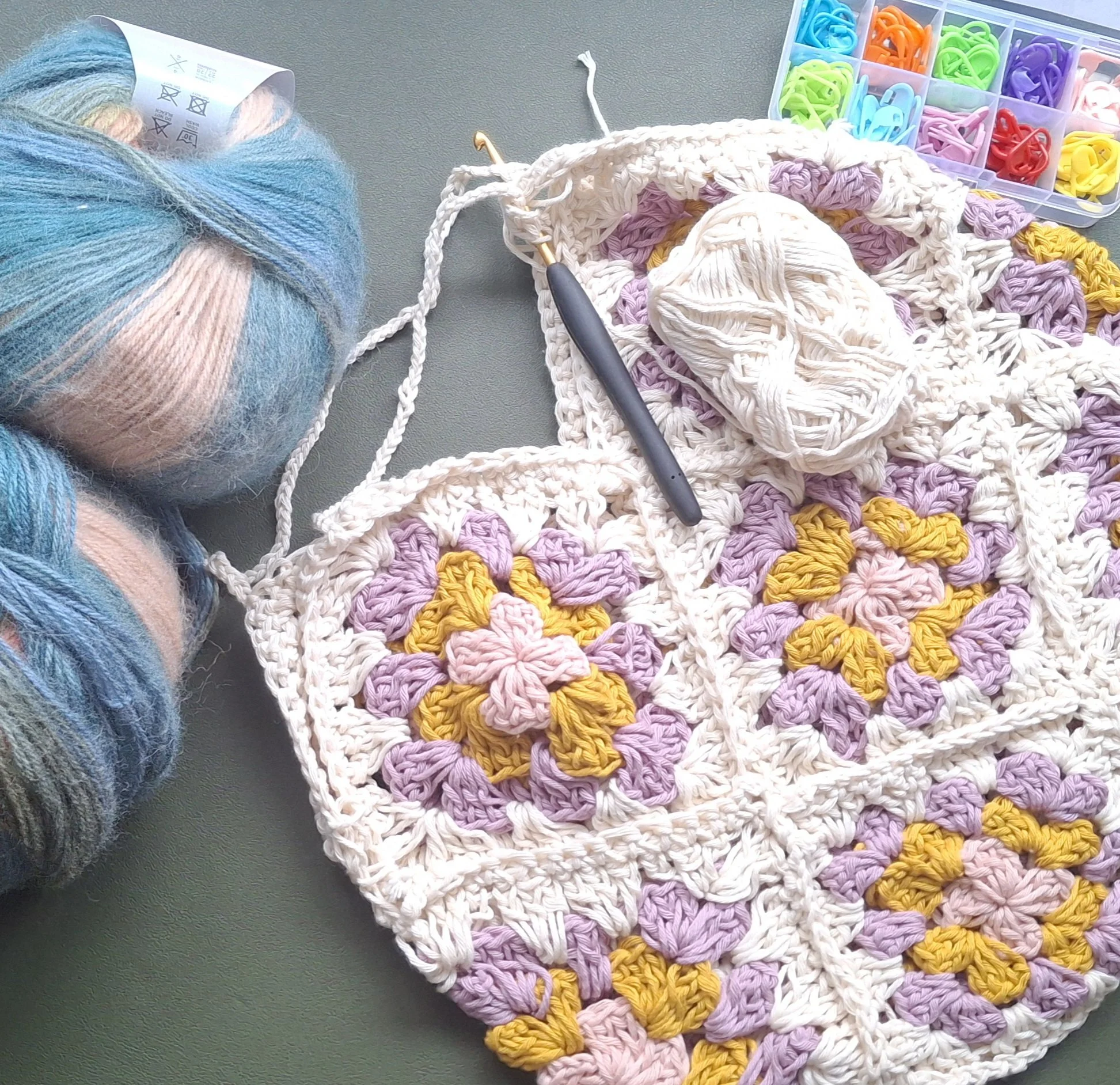
Photograph of an incomplete crochet granny square bag. Two balls of wall sit to the left of the bag.
2. Workplace stress is far more common than we might think
According to CharityComms' research into ways of working and organisational culture, 48% of charity communications professionals surveyed in 2025 said they often felt stressed at work, while 39% felt their workload was too much and prevented them from doing a good job.
Those figures are concerning, although sadly not particularly surprising.
Working in the voluntary, community and social enterprise (VCSE) sector often means wearing multiple hats.
In many ways, that's one of the things I've valued most about my career. I've had opportunities to develop skills, explore different areas of work and take on responsibilities I might never have encountered elsewhere. It's how I discovered my love of communications in the first place.
There's something incredibly rewarding about being resourceful and making things happen, particularly when you're working towards a cause you believe in.
The flip side is that the to-do list rarely gets any shorter.
When you're juggling service delivery, funding applications, reporting, communications, partnerships and everything else that keeps an organisation running, it's easy to become overwhelmed.
There's also an expectation, sometimes from others and sometimes entirely self-imposed, that we should somehow know how to do everything.
Being committed to a cause doesn't mean we have unlimited capacity to deliver it.
I think that's something we need to talk about more openly across the sector.
3. You don't have to do everything yourself
This is perhaps one of the biggest lessons I've taken from my experience, and it's something that now shapes how I work with charities and community organisations.
Having spent years juggling different responsibilities, I know how easily communications can become another thing on an already overflowing to-do list. You want to tell your organisation's story, reach the right people and demonstrate your impact, but finding the time to plan and deliver it all can feel impossible.
And that's just the external side of things.
Good internal communications is fundamental to a healthy, effective organisation. When people understand what's happening, why decisions are being made and what's expected of them, they're better equipped to do their jobs. Equally, unclear communication can create confusion, unrealistic expectations and unnecessary pressure.
It's not just about sharing information either. It's about listening, creating opportunities for dialogue and building a culture where people feel comfortable asking questions or raising concerns.
Sometimes the answer isn't to work harder or squeeze more into your day. It's recognising where you need additional capacity, specialist knowledge or simply a fresh perspective.
That's where freelancers and consultants can make a real difference.
Whether it's developing a communications strategy, strengthening internal communications, providing training or supporting day-to-day delivery, external expertise can give overstretched teams valuable breathing space and help organisations focus on what really matters.
Of course, bringing in external support won't solve every organisational challenge, but it can help make better use of limited resources, reduce unnecessary pressures and get important work moving.
4. Success looks different to me now
Nine months into self-employment, I still care deeply about doing a good job. I still want to deliver excellent work for my clients, build a successful business and make a positive contribution to the sector I've spent my career working in.
What has changed is how I define success.
It's no longer just about how much I can achieve or how many things I can tick off a list.
It's about doing meaningful work, having the freedom to spend time with the people I love and building a working life that's sustainable.
I'm not going to pretend self-employment is stress-free. There's uncertainty, responsibility and the occasional moment of wondering where the next piece of work will come from!
But I'm learning that I don't need to prove my worth by being permanently busy and that's progress.

Photo of Kelly wearing sunglasses eating a ‘Beacon Farm’ ice cream.
A final thought
This year's Stress Awareness Day theme asks us to think about rehumanising the workplace.
For me, that means remembering that behind every job title, project deadline and overflowing inbox is a person.
Someone with a life outside work, responsibilities we might not see and limits that deserve to be respected.
It means creating workplaces where asking for help isn't seen as weakness, where expectations are realistic and where people aren't valued solely by how much they can produce.
If you're leading a charity or community organisation, perhaps it's worth asking yourself a few questions:
Are we clear about what matters most, or are we trying to do everything?
Do our staff have the time, skills and resources to meet the expectations placed on them?
Are there things we could stop doing, simplify or approach differently?
Where could additional support make the biggest difference?
Sometimes the most productive thing we can do is acknowledge that something needs to change.
And sometimes, asking for help is the first step.
Need some breathing space with your communications?
I work with charities, community organisations and social enterprises to bring clarity, focus and practical support to their communications.
Whether you need a clear strategy, help getting things moving or additional hands-on capacity, I can work alongside your team to make communications feel more manageable and purposeful.
If that sounds like something your organisation could benefit from, I'd love to have a conversation or feel free to have read further on how I can help your organisation.